 English


For power quality engineers and grid operators, maintaining the reliability of critical compensation equipment like Static Synchronous Compensators (STATCOMs) is paramount. At the heart of this reliability lies an often-overlooked system: the cooling solution. As STATCOM capacities surge to meet modern grid demands—reaching hundreds of MVAR—the thermal management of their high-power insulated-gate bipolar transistors (IGBTs) and silicon-controlled rectifiers (SCRs) becomes a defining engineering challenge. This is where Water Cooled STATCOM technology decisively outperforms traditional methods, transforming heat dissipation from a limitation into a catalyst for superior performance. By leveraging the exceptional thermal properties of water, these advanced systems ensure unparalleled cooling efficiency, enabling higher power densities, enhanced reliability, and more compact installations.
This article delves into the engineering principles, comparative advantages, and innovative designs that make water cooling the benchmark for high-performance STATCOM applications.
To understand the inherent advantage of a Water Cooled STATCOM, one must start with the fundamental physics of heat transfer. The primary goal of any STATCOM cooling system is to efficiently move heat generated by semiconductor switching losses from the power electronic components to the ambient environment. The rate at which this is possible depends on the thermal conductivity and heat capacity of the cooling medium.
Air, used in forced air cooling systems, has a low thermal conductivity (approximately 0.024 W/m·K). While forcing air over heat sinks with extended surfaces (like fins) increases the effective area for convection, it remains a relatively inefficient process. It requires large, noisy fans and substantial space for airflow paths, ultimately limiting the heat dissipation capacity per unit volume.
In stark contrast, water boasts a thermal conductivity about 25 times greater than air (approximately 0.6 W/m·K). More importantly, its volumetric heat capacity is over 4,000 times that of air. This means water can absorb a massive amount of heat with a minimal rise in temperature. In a closed-loop cooling system, this high-efficiency heat transport allows for a much smaller temperature gradient between the power semiconductor junction and the coolant. This direct translation to engineering benefits is profound: it allows IGBT modules and diode bridges to operate at lower, more stable temperatures, significantly reducing thermal stress and enhancing service life.
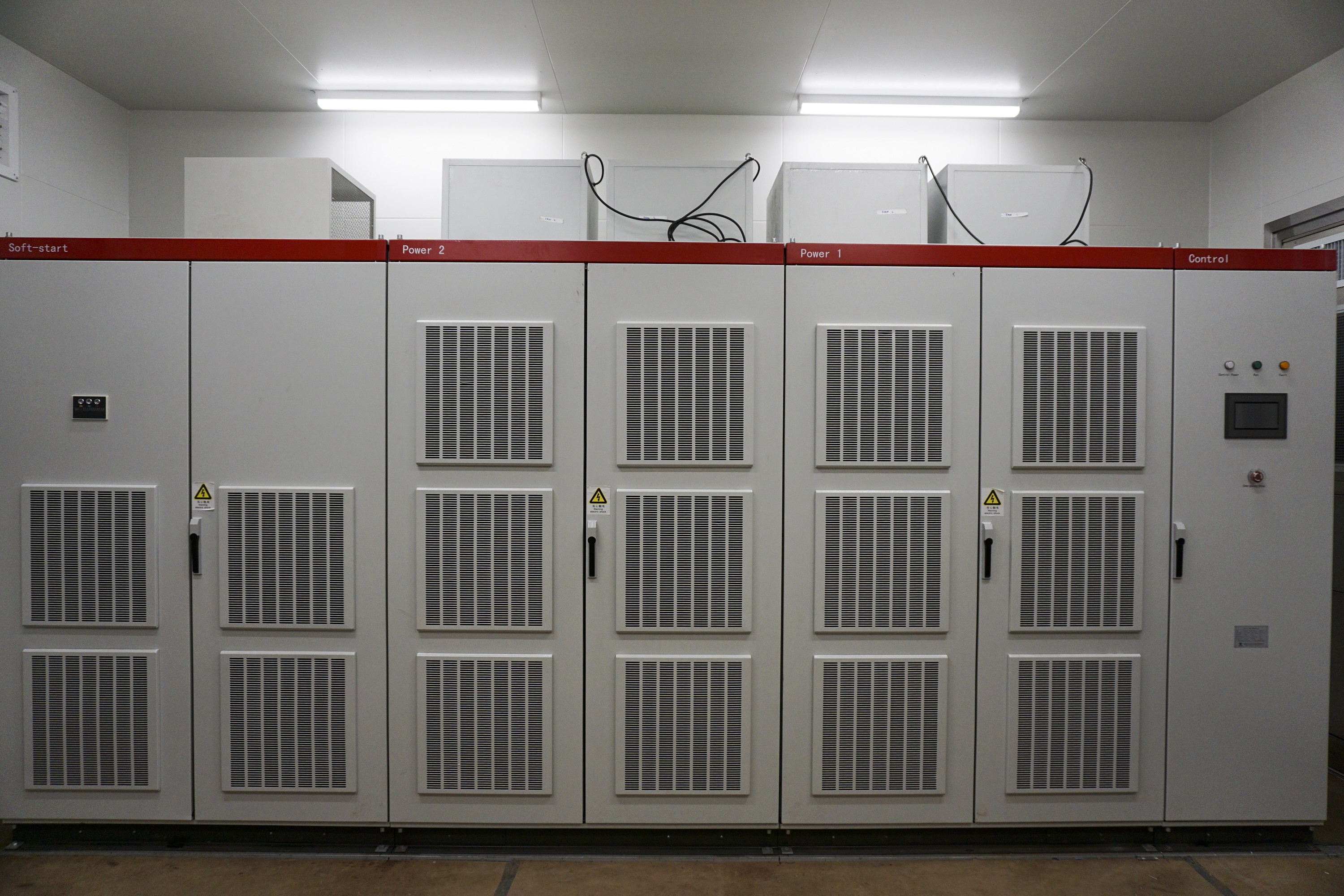
The theoretical superiority of water is borne out in direct technical comparisons. Research on cooling methods for high-power static converters like STATCOMs and Static Frequency Converters (SFCs) quantifies these differences clearly.
A Water Cooled STATCOM system is far more than just pipes running to the power modules. It is a precisely engineered, closed-loop ecosystem designed for reliability and efficiency. The system typically comprises an internal coolant circuit and an external heat rejection circuit, separated by a plate heat exchanger.
The internal circuit uses deionized water or a water-glycol mixture with extremely low electrical conductivity. This is critical because the coolant runs through cold plates in direct contact with live power semiconductor substrates. Even slight conductivity could lead to leakage currents or electrical breakdown. Systems incorporate a deionization resin cartridge that continuously purifies the coolant, maintaining resistivity at levels often exceeding 1 MΩ·cm.
Key components of the internal loop include:
Coolant Distribution Manifold: Evenly distributes flow to parallel cooling paths for each IGBT stack or thyristor.
Cold Plates: Mount directly onto power modules, featuring micro-channel or optimized fin structures to maximize contact area and heat transfer.
Circulation Pump: Provides constant, regulated flow. Modern systems use variable-speed pumps for energy-efficient operation based on thermal load.
Expansion Tank: Compensates for coolant volume changes and helps degas the system.
Sensors: A network of temperature sensors, flow meters, and conductivity sensors provide real-time data to the monitoring and control system.
The external loop's role is to reject the collected heat to the atmosphere. This can be achieved via a cooling tower, a dry air cooler, or by exchanging heat with a facility's chilled water supply. Advanced control systems, often using proportional-integral-derivative (PID) control algorithms, modulate three-way valves and fan speeds on the external cooler to maintain the internal coolant at a precise setpoint temperature, optimizing overall energy efficiency.
The pursuit of ultimate cooling efficiency and reliability drives continuous innovation in Water Cooled STATCOM design. One significant trend is the move toward compact valve group designs. Researchers have developed modular, three-layer valve groups where silicon stacks, capacitors, and gate drive units are integrated with a unified coolant manifold. This design minimizes coolant hose lengths, reduces flow resistance, and standardizes maintenance, all while shrinking the overall footprint.
Another frontier is the exploration of two-phase cooling and advanced heat sink technologies. While traditional water cooling is a single-phase (liquid) process, two-phase systems utilize the latent heat of vaporization of a working fluid (like R245fa) for even greater heat transfer coefficients. Experimental studies on novel heat sinks coupling natural convection and phase transition have shown excellent performance for distribution-level STATCOM (DSTATCOM) cooling, achieving high heat dissipation with minimal temperature rise across the heat sink. Although not yet mainstream for large transmission-level STATCOMs, this research points to a future of ultra-compact, passively cooled, or hybrid cooling solutions.
Furthermore, system intelligence is becoming standard. Modern water cooling units feature industrial internet of things (IIoT) connectivity and touch screen human-machine interfaces (HMIs). They don't just cool; they predict. By analyzing trends in temperature rise, flow rates, and coolant conductivity, these smart systems can alert operators to potential issues like fouling in the heat exchanger, pump performance degradation, or resin bed exhaustion in the deionizer, enabling predictive maintenance.
Choosing and implementing a Water Cooled STATCOM requires careful consideration of several factors beyond pure thermal performance.
Reliability and Redundancy: Critical installations often feature redundant pumps and N+1 cooling capacity to ensure uninterrupted operation even during a component failure. The control system must seamlessly switch between active and standby units.
Material Compatibility: The entire internal loop—including cold plates, piping, seals, and the plate heat exchanger—must be constructed from corrosion-resistant materials like stainless steel or specialized plastics to ensure long-term integrity with deionized water.
Freeze and Over-Temperature Protection: In cold climates, glycol mixtures and integrated heater elements prevent freezing. Conversely, high-ambient conditions require properly sized external coolers and may incorporate chillers to maintain coolant temperature within safe limits.
Leak Detection and Mitigation: A core concern with any water-based system is leakage. Designs employ drip trays, moisture sensors, and pressure monitoring to provide early warnings. Containment strategies ensure any leak is directed away from electrical components.
Total Cost of Ownership (TCO): While the initial capital expenditure (CAPEX) for a water-cooled system can be higher than an air-cooled equivalent due to additional components like pumps, heat exchangers, and water treatment units, the total cost of ownership often favors water cooling. The savings come from reduced floor space, lower facility cooling costs, higher energy efficiency of the STATCOM itself (due to cooler, lower-loss semiconductors), and potentially longer component life.
Q: Aren't water-cooled systems more prone to failure and leaks than simple air-cooled systems?
A: While the system is more complex, modern Water Cooled STATCOM units are engineered for industrial reliability. Leak risks are mitigated through robust design, pressure testing, and integrated leak detection systems. The reliability of the core power electronics is often enhanced due to superior and more stable thermal management, which can lead to higher overall system availability compared to air-cooled alternatives operating at higher thermal stress.
Q: What is the regular maintenance required for the water cooling system?
A: Maintenance is planned and systematic. It typically includes periodic checking of coolant conductivity and pH, replacement of deionization resin cartridges, inspection of pump seals, and cleaning of the external heat exchanger's air-side filters or fins. These tasks require specific expertise but are less frequent than the constant filter changes needed for forced air cooling in dusty environments.
Q: Can a water-cooled STATCOM be installed outdoors, and how does it handle extreme ambient temperatures?
A: Yes, with proper enclosure ratings (e.g., IP54). For outdoor containerized STATCOM solutions, the external heat rejection loop is designed for the site's specific climate range. In hot climates, larger coolers or chillers are used. In cold climates, the system includes glycol for freeze protection and controls to pre-heat the coolant before startup.
In the high-stakes realm of grid stability and power quality mitigation, the choice of cooling technology for a STATCOM is far from a minor detail. It is a strategic decision that impacts footprint, efficiency, reliability, and total cost of ownership. Water Cooled STATCOM systems, through their superior heat dissipation capacity and precise temperature control, provide an engineering solution that unlocks higher performance tiers. They enable the compact, megawatt-scale compensators needed for modern renewable energy integration, voltage stability projects, and industrial applications. As technology advances with smarter controls and novel thermal materials, the efficiency gap between water and air cooling will only widen, solidifying water cooling's role as the cornerstone of high-performance, high-reliability power electronic systems. For companies like Zhuhai Sinopak Electric Ltd., integrating advanced and reliable water cooling systems into their STATCOM solutions is a direct response to the market's demand for more efficient, compact, and robust power quality equipment that can meet the stringent demands of today's dynamic grid.


